National Lawn Sprinklers, Inc. started as a small company that installed sprinkler systems at local residences. John's outstanding service and loyal clientele helped grow the business into one of the leading sprinkler companies today. We install and service golf courses, parks and state, local and national government facilities such as the US Military Academy at West Point and the United Nations in New York City. We also serve private clients and design, install, maintain and service more than 3,000 customers in the tri-state area. Among our clients are some of the most prestigious estates in Westchester and Fairfield Counties.
Why are National Lawn Sprinklers, Inc's customers so loyal? John loves what he does and has earned his clients trust by demanding and maintaining a high standard of integrity which has resulted in an excellent work ethic. All of the employees are hired by John himself and are trained by the company to meet the utmost standards set by the owner. John not only pays attention to detail, but also supervises and approves all work.
National Lawn Sprinklers, Inc. is experienced in providing the right service to ensure complete customer satisfaction. The service does not end when the installation is finished. Johns team goes far beyond the call of duty, and does more than anyone expects. This is what excellence is all about. It comes from striving, maintaining the highest standards, looking after the smallest detail, and going the extra mile. Excellence means doing your very best.
John Luciano was born and
raised in Airola, Italy. By the
age 14, he knew he wanted to
work with water. As a teenager,
he worked for a well drilling
and water exploration company;
later he joined a large irrigation
and plumbing company whose
primary customers were large
estates and farms.
John had always dreamed of exploring the world and eventually settling in the United States. He fulfilled his dream and settled in Westchester in the early 80s. After
managing Energy Saving Experts, a lawn sprinklers company that was later acquired, John was ready
to go out on his own.
We proudly offer the following:
• Licensed & Insured Quality
• Installation & Repairs
• Free Estimates
• Local References
• Prompt Responses & Scheduling
• Manufacturer's Warranty
• Maintenance & Service Contracts
An automatic sprinkler system is one of the best investments you can make in your home. It provides you with a healthy and beautiful landscape, saves you money, and frees up your time to engage in the activities you truly enjoy.
Planning a short summer getaway? Worried about who will water the lawn? No problem, your automatic sprinkler system will precisely apply the correct amount of water needed for your lawn and garden during the hot summer days. A rain sensor to your irrigation system will keep it from running during rain events.
Our qualified irrigation staff will provide you with an installation quote and a full presentation package. The materials we use are supplied by leading manufacturers like Hunter, Rain Bird and Toro. They are of pop-up design and retract in the ground (out of sight) when not operating. The system is fully automatic and is equipped with a multi-function timer.
Planning
Products
After meeting with you and discussing your irrigation needs and concerns, we will design the correct
irrigation system for your project. As a part of our planning process, we will:
• check your projects service meter size and obtain
the static water pressure from the municipality;
• calculate friction loss in order to make correct pipe
sizing selections and
• review basic hydraulics to determine the correct
number of valves and branch lines
We use the finest quality products and select
the proper sprinkler heads based on the
following factors:
• size and shape of areas to be watered
• types of plant life and soil conditions on the
project site;
• your budget and preferences for the various
pop-up sprinklers, rotating sprinklers, bubblers
and drip irrigation devices available
Water Saver Tips
Questions & Answers
Installation
Service
Lawn Care Tips
Proper installation will ensure correct system performance, reliability, and durability. During
installation we will:
• meet all local backflow preventor codes:
• leave each project site clean and orderly when
the system is completed or at the end of each day
where the job requires more than one day to complete
• full demonstration of equipment upon completion
Our service to you will include:
• your approval prior to any work being performed;
• prompt reply to all your inquiries;
• a full maintenance program to include a spring
activation and annual blowout to protect your
system from freezing damage.
Warranty
All of our irrigation systems are backed by a two year warranty on all workmanship. National Lawn
Sprinklers, Inc. will be responsible for the warranty obligation and we can be reached at the following
numbers 914-946-6666 or 203-662-6666 or by emailing us at info_natlawn.com.
For More Product Info Click on Logos Above
At National Lawn Sprinklers, we understand that water is a very precious resource. The tips listed below will help you water more efficiently and responsibly.
• Keep the soil consistently moist but not wet. This eliminates runoff, and ensures
your plants a steady supply of water.
• Do not water at night - water will sit on the lawn and may cause disease.
• Water early in the morning - evaporation is minimized and the lawn utilizes the most
water.
• When programming your irrigation timer, adjust the run times and frequency of
watering based on local weather conditions, seasonal changes and watering needs
of your landscape.
• Install a rain sensor - it will prevent the system from running during rain event.
• Use drip irrigation in flower beds - it saves substantial amounts of water.
• Reduce the run times for zones in the shade.
• Install Hunter Solar-Sync. This will provide automated daily adjustment to program
run times applying only the water needed for each day.
• Sharpen your mower blade sharp blades are easier on the grass and save water.
• De-thatch your lawn water will get to the roots faster and evaporate less.
• Aerate your lawn it prevents soil compaction and improves water infiltration rates.
• In hot weather, keep the grass taller this will help reduce the soils exposure to the
sun and allow the soil to hold onto the moisture for a longer period of time.
• Keep plants with different watering needs on different zones trees vs. lawn etc
• Mulch flowerbeds and trees using 2-4 inches improves water penetration while
controlling weeds that compete for water.
• Know your soil type the three basic types: sand, loam, and clay require different
watering schedules for optimal results.
• Inspect your irrigation system monthly for leaks, clogged or broken sprinkler heads
and other problems.
By implementing these conservation tips, your water use can be cut dramatically, helping to preserve the water supply.
Q: Do I need a backflow preventer on my irrigation system?
A: You must have a backflow preventer on your irrigation system.
In most places this is the law, everywhere else its just the smart thing to do. Almost everywhere the local authorities will dictate that certain types of backflow preventers may not be used with irrigation systems because they do not provide adequate protection. In some cases, the authorities will dictate the exact type of backflow preventer you MUST use. You may hear or see the term Cross-Connection Control used, this essentially is referring to backflow prevention.
Q: Will the installation damage my lawn?
A: National Lawn Sprinklers uses state of the art equipment to install your irrigation system with minimal disruption to your existing lawn. The pipe is pulled beneath the surface without trenching.
Q: When should my irrigation system be turned on?
A: A homeowner should call us sometime around March 1st, depending on the weather, and have us come out to get your system up and ready for the summer. At a spring Turn-On a technician will come to your home, turn your water on, program your controller and run and adjust all heads. At that time they will do any repairs on the system.
Q: When should my system be winterized?
A: Your system should be winterized in the early part of October. A technician will come to your home, turn off your water, drain the water from the pipes and blow air through your lines to make sure no problems occur during winter time freezing.
Q: What is a rain sensor and is it beneficial?
A: A rain sensor is a device that hangs from the outside of your home to measure the amount of rainfall we have had. If the rainfall exceeds a certain amount it then sends a signal to your controller to stop watering until the rain sensor dries out. These devices come in either wired or wireless for easy installation in any application.
Q: How long will my installation take?
A: The length of any installation varies from job to job but a normal residential yard takes one to two days to complete.
Q: What is the order of operation for a landscape project?
A: One should first start by constructing a landscape design or plan that show exactly what needs to be done. All finish grade should be done then we can come in and install the irrigation. After that all plants, sod, and bed material can be brought in and installed.
Q: Can I ever add onto my system in the future?
A: One can usually always add onto a system after it is installed. It is a great idea to know where other irrigation was run before adding on. It is helpful to have enough extra wire and space in the controller for additional zones.
Mow the lawn properly
For the best appearance and good health of lawn grass, mow high using a sharp blade. A dull blade will tear rather than cut the lawn leaving a ragged end on the grass blades that cast a dull haze over the lawn. That ragged edge also leaves the grass more vulnerable to disease. Depending on the size of the lawn, a mower blade becomes dull after one or two seasons and should be sharpened or replaced every year or two. Grass that is dense and cut over 2-inches tall has few weeds and serves as habitat for ants, spiders, and ground beetles which keep the pest insects of a lawn in check. Tall grass shades the soil reducing evaporation of moisture and will not burn out in the heat of summer. Set the mower for 2 to 2-1/2 inches in the spring and fall and raise it to 3 inches in summer.
Use only slow release granular fertilizer
Quick release nitrogen fertilizers need to be applied three or four times a year in order to be effective. High in salts, the increased salinity burns turf roots and repels the valuable earthworms and kill many of the beneficial soil microbes. Slow release nitrogen fertilizer needs to be applied only once or twice a year and will not hurt the soil critters. Use slow release nitrogen fertilizer in the spring and again in the fall for a few years, but if you are taking care of your soil, you can drop back to a single application in the fall, or split the application putting down half the recommended amount in spring and half in fall.
Avoid watering too much or too little
The key questions in watering the lawn are: When does the grass need to be watered? and How much do I need to water?. When you walk over a lawn that is mowed tall, you will leave temporary footprints. If the footprints disappear with the grass popping back upright within a minute or two the grass has enough water. If the foot prints last more than 3 or 4 minutes, the lawn needs to be watered. In spring and fall between your hose and Mother Nature, give the lawn an inch of water each week. Lawns need two inches a week in the heat of the summer. An empty tuna fish can is one inch deep so put a few empty tuna cans out in the pattern of your sprinkler and track the time to see how long it takes to fill the cans and you can quickly figure how to deliver an accurate amount of water to the lawn. A rain gauge will help you keep track of Mother Natures contribution.
Avoid using any broad spectrum insecticides
A lawn that is dense and mowed tall is likely to be inhabited by a healthy population of beneficial insects, including ants, spiders, and ground beetles, seldom has any problems from fleas, grubs, sod webworms, chinch bugs or any other lawn grass insect pest. If you routinely use a broad spectrum insecticide each year, you will kill all the good guys along with the bad guys. If the grass is mowed tall and kept dense from overseeding, those beneficial insects will eliminate the need for the annual use of the insecticide.
Spread lime only if needed in late fall, not in the spring
Use lime on the lawn only if you are sure that your soil is acidic enough to justify it. A soil test is the only accurate way to tell. Contact your County Extension Service to get a soil test kit and related information. If you do apply lime, use a granular lime product in October or even in November. It takes six months for granular lime to break down sufficiently to be helpful to the grass plants.
Buy only the highest quality grass seed
Only the top quality grass seed includes varieties that have been bred with good disease resistance, look good, and are drought resistant. When you buy the high-end brands, you can trust the grass seed companies to give you the right mixture for the northeast. Buy full sun mix if your lawn gets over 6 hours of sun a day. Use a shade mixture if your lawn gets 3 to 6 hours of sun a day. Any lawn getting less than 3 hours of sun a day must be overseeded every spring to look even average for the season.
Get rid of grubs and moles by growing good soil
Grubs and moles are only a problem in lawns that are compacted and have turf with roots only two inches deep. If you add organic matter to the soil under your turf on a yearly basis, the earthworms and soil microbes lower the level of compaction over time, so after 3 to 5 years, the grubs and moles are working down at the 4 to 6 inch depth and are not evident in your lawn.
National Lawn Sprinklers, Inc. has been in the commercial irrigation market for decades. Commercial projects encompass a variety of types from multi-family townhouse complexes to high rise condominium towers, green roof tops to shopping centers. National Lawn Sprinklers has succeeded at all types of projects. Along with the installation, we provide a complete certified design service, using RainCAD (computer aided irrigation design). Our commercial clients include construction and development companies, property management firms, commercial landscape companies, and architects.
Smart Irrigation
• Toll Brothers, Inc. - Fishkill, NY
• United Nations - Manhattan, NY
• Mastercard International - Purchase, NY
• Westchester Medical Group - White Plains, NY
• River Oaks Condos - Stamford, CT
• SCA Commerical Real Estate - Westport, CT
• Albert Einstein College - Bronx, NY
• Barlow Mountain School - Ridgefield, CT
• Glenfield Park - Montclair, NJ
• Hamilton Park - Waterbury, CT
• Lawerence Thompson Park - Staten Island, NY
• Hurrell Field - Glenridge, NJ
• Wahconah Park - Pittsfield, MA
• Yanticaw Park - Nutley, NJ
• West Harlem Waterfront - New York, NY
• Noble Park - Bronx, NY
• Southington High School - Southington, CT
• Fairfield Country Day School - Fairfield, CT
• William Warren Park - Woodbridge, NJ
Green Roof Irrigation
"Smart Controllers" are controllers that automatically update the watering schedule to allow for changes in water needs throughout the year. So a smart controller will automatically reduce the watering times as the weather gets cooler and less water is needed. Then as the weather begins to warm up, the controller will add more watering time. The way this typically works is that you set the controller for a default maximum watering time, based on the hottest time of year. Then the controller reduces that time amount by a percentage value when less water is needed. There are several methods used by different controllers to determine how much to reduce the watering time. Some controllers may allow for use of more than one method. Here's a list of the common methods used by smart controllers to determine the watering time:
Uses historical weather and water data for your area to determine what amount of water is required. Typically it only resets the time monthly. While the historic data is not perfect, it still gives significant water savings for most users. You will periodically need to manually override the automatic controller settings, especially if you have unusually hot weather for the month. To setup the controller on some models you simply enter your zip code and it accesses the historic data from it's memory. On others you have to initially key in the historic data from the user's manual or a website. Due to the lower cost of this type of smart controller, often it will give you the best financial return on your investment. This is especially true for a small residential irrigation system.
Uses historical data to determine an initial reduction in watering time, but then further adjusts the time based on a sensor. Typically a temperature sensor is used. If the daily high temperature is higher than the historical data says is normal, it adds more time, if the temperature is lower, it reduces the watering time. This gives more accuracy that the historic data alone will.
Uses water and/or weather data provided by a remote provider. The controller uses a radio, Internet, or phone connection to obtain the data from either a central data provider, or from a local weather station. Generally there is a subscription charge for the data service and there may also be charges for the telephone, Internet, or radio link. Accuracy is dependent on where the data is obtained from (garbage in, garbage out). If the data comes from a nearby weather station it can be very accurate. If it comes from a central data base of historic data that is expertly manipulated for current conditions it can be very accurate also. So with this type of smart controller you need to ask the provider exactly where the data would come from for a controller installed at your location.
This controller has it's own weather station that you install with it. It uses real-time data from the weather station to adjust the watering times.
A moisture sensor (often more than one) is placed under the irrigation system to measure the actual amount of moisture in the soil. The irrigation time is based on the amount of moisture present. There are several types of sensors available. Some require regular maintenance, others do not. There are advantages and disadvantages to each type of sensor. Do some research, as different types of sensors work better with some types of soils than they do with others. Be prepared to spend some time calibrating the sensors and making adjustments. With that said, this is a very accurate method of determining watering times.
An aerial view of most urban areas shows swathes of asphalt, black tar and gravel-ballasted rooftops. Heat radiates off of the dark roofs, and water rushes over the hard, hopefully impermeable surfaces. Yet, there is a new trend that breaks up the monotony of common roofs: green rooftops. Long popular in Europe, green rooftops have begun to appeal to homeowners, businesses and even cities as an attractive way to promote environmentalism while solving the problems of conventional roofs. Green roofs supplement traditional vegetation without disrupting urban infrastructure -- they take a neglected space and make it useful.
Green roofs last longer than conventional roofs, reduce energy costs with natural insulation, create peaceful retreats for people and animals, and absorb storm water, potentially lessening the need for complex and expensive drainage systems. On a wider scale, green roofs improve air quality and help reduce the Urban Heat Island Effect, a condition in which city and suburban developments absorb and trap heat. Anyone who has walked across a scalding parking lot on a hot, summer day has felt one effect of an Urban Heat Island.
The layers of a green roof must, like any roof, accommodate drainage and protect the building from the elements with a waterproof membrane. But they also must create a growing area and potentially provide support, irrigation and root protection barriers while staying as light as possible.
Two types of green roof exist: intensive and extensive. Intensive green roofs are essentially elevated parks. They can sustain shrubs, trees, walkways and benches with their complex structural support, irrigation, drainage and root protection layers. The foot or more of growing medium needed for an intensive green roof creates a load of 80-150 pounds (36-68 kilograms) per square foot. Extensive green roofs are relatively light at 15-50 pounds (7-23 kilograms) per square foot. They support hearty native ground cover that requires little maintenance. Extensive green roofs usually exist solely for their environmental benefits and don't function as accessible rooftop gardens.
• 100 Park Ave. - Manhattan, NY
• African Musuem - Harlem, NY
• Union Square - Manhattan, NY
• Continental Hotel - Manhattan, NY
• The Visionaire - Battery Park City, NY
• CBS Building - Manhattan, NY
• 44 Holland Ave - Albany, NY
• Jacob K. Javits Convention Center
(300,000 sq. ft. ) - Manhattan, NY
Does your lawn have brown spots? If it does it might be a sign your irrigation system needs repairs. When repairs need to be made, we will ask for your prior approval. If you are considering changing your landscape, it is important to consider changes to your irrigation system. Sometimes relocating trees or shrubs will require changing or moving sprinkler heads to more effectively water your new landscape. In addition, if you have had your irrigation system for a number of years you may want to consider a tune-up. As your landscape grows, heads may need to be adjusted or relocated in order to ensure your entire yard is effectively watered. It is important to remember to protect your landscape investment with an adequate irrigation system.
We carry advanced wire tracing and detecting equipment to find lost valves, repair broken subsurface wires, and trace mainlines. We also have sophisticated equipment that gives us the ability to replace broken lines under driveways, sidewalks, and parking areas in most cases.
With factory trained service personnel, warranty related or non-warranty related problems can be fixed quickly. Whether its a scheduled service call, or a mid-season emergency, our service personnel at National Lawn Sprinklers, Inc. are here to exceed your expectations.
March - May • Spring Start-Up
• Reseal all drain valves and plugs
• Open the shut off valves and slowly fill the mains
• Check the entire main for leaks or damage
• Check each individual zone and adjust heads for
proper operation and coverage
• Check and adjust the automatic rain sensor for
proper operation
• Reset the control timer
for required settings for
the spring season
Call for Service
914.946.6666
203.662.6666
or fill out form below
June - August • Summer Inspection
• Adjustments will be made based on changes in
shrub growth or varying weather conditions
• Main and lateral lines will be inspected for leaks
• Check and adjust the
automatic rain sensor(s)
for proper operation
October - December • Winterization
• Close down all water sources to the irrigation
system only
• All drain valves and drain plugs will be opened
• All main lines, valves, lateral lines and heads will
be blown out with compressed air.
• The lines will be flushed with air until completely
empty
• Control timers will be
set in the rest position
National Lawn Sprinklers Inc. is one of the leading installers of golf course irrigation systems in the Northeast. For over three decades National has provided golf course installations with little or no impact to the golf course. Whether it is new installation or the renovation of an existing system, we will provide the resources to complete your project on time and on budget. With our competitive pricing you can be sure that your golf course will receive our fullest attention from start to finish. Our project managers have the field experience and management skills to provide the customer with a reliable and durable irrigation system. You will receive our in house GPS mapping system that is in progress from the as-staked map through the installation to the final as-built giving you an accurate record of all material installed. Our team has worked with some of the top designers in the industry. We work closely with the golf course superintendent to ensure all concerns are addressed and the flow of work is performed to your satisfaction. At National Lawn Sprinklers we will always meet or exceed your expectations.
National Lawn Spinklers has two large compressors with 3" hoses to ensure your system is free of water durning the winter. Blow outs are completed in one day eliminating a long process using smaller compressors.
• Irrigation heads
• Main lines
• Lateral Lines
• Electrical wires
• Valves
• Satellite controllers
• Greens
• Tees
• Bunkers
• Fairways
• Cart paths
• Ponds
• Streams
National Lawn Spinklers prides itself that we are always there for your emerencys whether it is during the week or on the weekend. We will send a trained crew to get you up and running.
If you are building a new tee, bunker, green or need work around the club house National Lawn Sprinkler will take care of your irrigation needs.
National Lawn Spinklers can install new grounding on your old controllers to improve your grounding grid and reduce your chances of lightning damage.
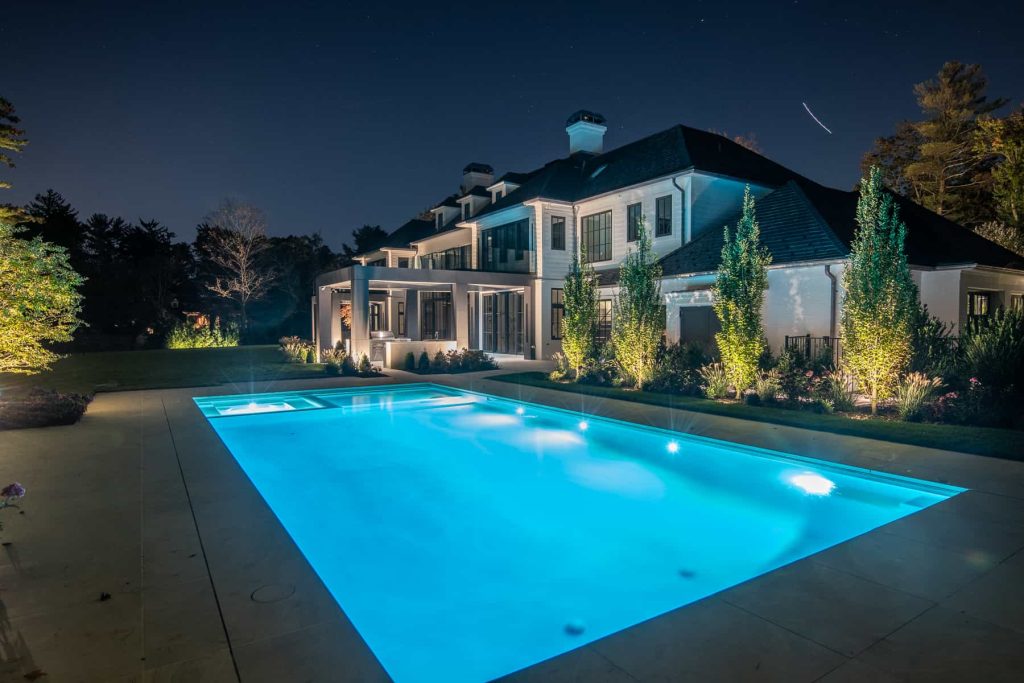
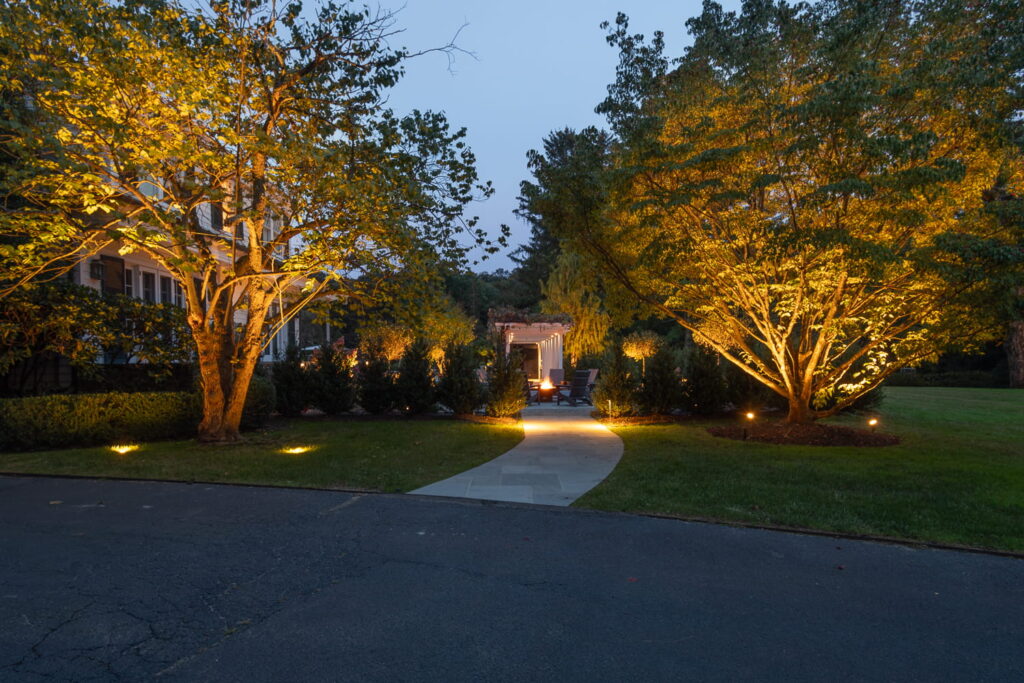
National Lawn Sprinklers lighting system will bring beauty, convenience and security to your outdoor landscape. Illuminate a stunning facade, a charming patio, planting or water feature in the soft, ambient glow of low voltage lighting to add aesthetic and practical enjoyment to any natural environment. National Lawn Sprinklers offers an extensive selection of exciting designs to complement any outdoor setting, from country charm to sophisticated urban. Available for path, deck, water and accent lighting, the 12-V, 24-V or LED collection offers flexibility in design and convenience of installation to meet the changing needs of a homes landscape over the years. National Lawn Sprinklers low voltage systems have a practical side, too low wattage can achieve a wide range of lighting effects with energy efficiency. The perfect medium of creative expression for discriminating homeowners, National Lawn Sprinklers invites you to discover the beautiful possibilities of low voltage lighting for bringing the brilliance of nature to light.
Nothing has a greater effect on the comfort of an individual than the quality of light. Think about how you feel when approaching a dark house compared to how you feel when entering the property of a beautifully illuminated home. The lighting designer recognizes this and creates a scene where the viewer is an active participant. This scene presents a cohesive panorama framed by the borders of the property. Lighting displays the beauty of the landscape and highlights the architectural features of the building.
Security from theft and trespassing is
a primary concern for all homeowners and is usually addressed with high voltage floodlights. A better choice is strategically placed low voltage lights that provide low levels of illumination evenly distributed around the property. This avoids the problem of glaring lights that leave unseen areas in the shadows.
Light defines textures, shapes and structures while evoking a wide range of positive emotional responses. A good lighting design can create moods that are soft and subtle or dynamic and dramatic. It can highlight features of the structure and property, while maintaining a cohesive scene. Good Landscape Lighting is a feast for the eyes.
Cohesion refers to the overall appearance of the scene as one continuous panorama. If there are unlit areas near illuminated ones, then the viewers visual experience is interrupted. These black holes detract from the beauty of the design and fatigue the eyes. Cohesion is achieved by illuminating borders, backgrounds, and intermediate areas with the creative use of fixtures placed for that purpose.
Depth refers to the strategic placement of fixtures using different light levels to achieve a three-dimensional scene. Depth requires lighting areas that are
in the foreground, in the middle, and in the back of the scene. The proper use of high, medium, or low wattage lamps (with varying beam spreads) helps establish depth by allowing the designer to create scenes that draw the eye from near to far.
Low voltage lighting is an ideal choice for illuminating walkways and entrance-
ways. This ensures that residents and visitors can safely navigate through the property avoiding otherwise unseen obstacles.
Illuminating the public and private areas of a property allow the home-
owner to enjoy decks, sitting areas and recreational spaces.
Keep in mind that the designer is not only painting a picture with lights, he or she is also directing a scene. In this scene, the viewers eyes are first drawn to one focal point then to another and so on. These focal points may be unique features of the property such as, statuary or water features; or they may be functional points such as entranceways, sitting areas, or gathering places.
Mastercard International
2000 Purchase Street
Purchase, N.Y. 10577
Curtis - Engineering
914-249-1077
United Nations
Peace Bell Garden - Ivy Garden
304 East 45th Street
New York, N.Y. 10017
John Grassi - Grounds Foreman
(212) 963-7252
Pace University
Finnerty Field - Pleasantville Campus
235 Elm Road
Briarcliff Manor, N.Y. 10510
JR Pouncey
(914) 773-3481
Fax: (914) 923-2726
Heywood Heights Condos
Hamilton Avenue - Cortlandt Ave
Stamford, Ct. 06095
Mike Lombardi
203-359-4611
Con Edison Pelham
847 Pelham Parkway
Pelham Manor, N.Y.
Casey Larcome
908-791-4800
Route 9W
West Street Promenade
NYS DOT
Tully - Cruz Construction
Joe Ghirardi
718-446-7000
Westchester Medical Group
210 Westchester Avenue
White Plains, N.Y.
Elmer
914-384-6863
Anker Management
200 Central Park Avenue
Hartsdale, N.Y. 10530
• Wyndham Close
• 19 Russell Street
• Whipporwill Commons
• Winding Brook
• Shore Road Plaza
• Gateway Apartrments
Robert Ferrara
914-490-9957
R.G.F Development
17 Heathcote Road
Scarsdale, N.Y. 10583
Schlomo Friedfertieg
914-406-9877
Modern Barn
430 Bedford Road
Armonk, N.Y. 10504
Dorex Corporation
Matt Moran
914-804-5204
Toll Brothers, Inc.
657 Creekside Lane
Fishkill, N.Y. 12524
• Van Wyck Mews
• Van Wyck Meadows
• Van Wyck Glen
• Regency _ Fishkill
Mike
646-210-1494
845-896-7616
Caslte Village
110 Cabrini Boulevard
New York, N.Y. 10033
Frank Nadal
212-927-0600
Pelham Shoppng Center
2 Secor Lane
Acadia Construction Realty
Elias
917-583-2433
TGI Fridays
2594 Route 9
Poughkeepise, N.Y.
Restaurant Specialties Inc
Joe Cruz
347-448-0271
100 Park Avenue
Roof Top Irrigation
New York, N.Y.
SL Green, Inc.
Anthony Citro
212-216-1693
River Oaks Condos
631 Long Ridge Road
Stamford, Ct. 06901
Mary Ann
203-918-6508
SCA Commercial Real Estate
166 Kings Highway
Westport, Ct. 06880
Steve Crowley
203-856-1548
Glenfield Park
21 Maple Avenue
Montclair, NJ
The Landtek Group
Jeff Long
631-691-2381
Hamilton Park
Plank Road
Waterbury, CT
Supreme Industries
Mark Vigeault
860-485-0343
Harwinton Athletic Fields
100 Bentley Drive
Harwinton, CT 06791
Bruce Anderson
860-883-2446
Hurrell Field
Belleville Avenue
Glenridge, NJ 07628
JC Landscaping
Peter Calabrse
973-703-4518
John Mulally Park
NYC Parks Department
Jerome Ave. & 164th St.
Bronx, NY 10452
Wm. Gross Construction
John Scopellitto
516-437-0909
College of New Rochelle
215 Liberty Avenue
New Rochelle, NY 10801
Fred Sullo
914-654-5555
East Mountain Park
Prospect Street
Waterbury, CT 06706
Rich Robbins
203-574-6793
Dover High School
100 Grace Street
Dover, NJ